▍When the Director of Titanic and Avatar Shoots a Billie Eilish Concert:
When we go to see a concert film, are we trying to return to the live scene, or are we trying to see a version more perfect than the actual live experience?
A concert film can never truly recreate the live event. It loses the air, the sweat, the screams from the person sitting next to you, and the vibration of bass pressing against your chest. Yet it gains another kind of power: it can choose the viewing position for the audience. So the real question is not “How close is it to the real concert?” but rather: what kind of spectator does it want us to become?
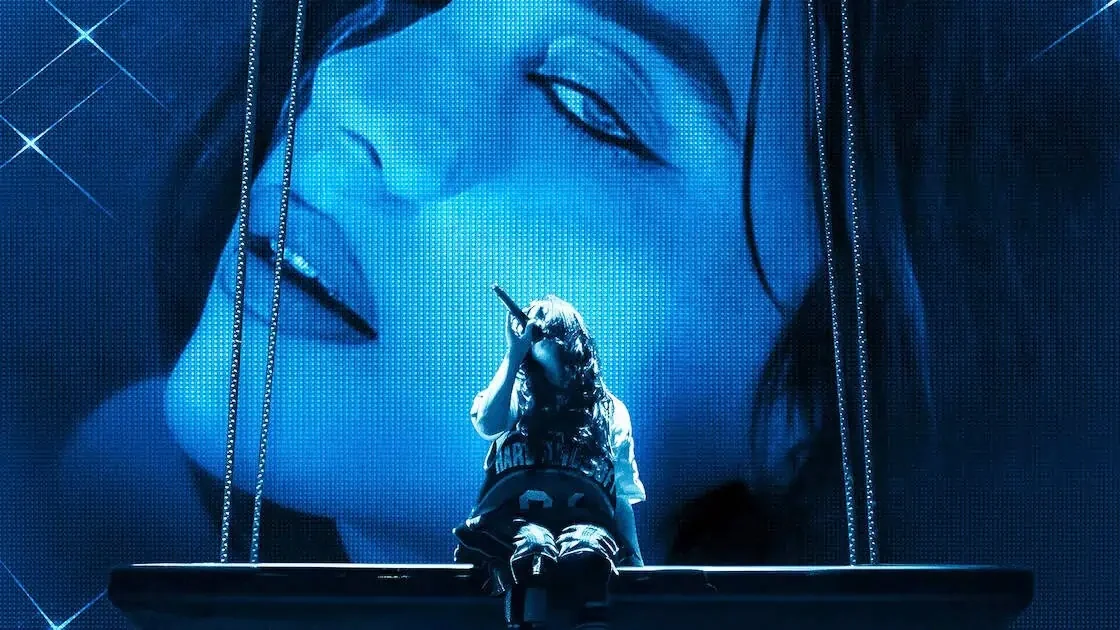
A while ago, I went to see Billie Eilish – Hit Me Hard and Soft: The Tour (Live in 3D). As an old fan who had already fallen into Billie’s world back in the〈Bellyache〉era, part of me felt moved watching this singer, who first entered pop culture as a teen idol, gradually gain clearer command over her voice, body, and creative language. At the same time, certain features of the film, such as the audience noise being pushed extremely far forward and the physical pressure created by 3D, reminded me of the more polished and stable sound treatment in Taylor Swift’s The Eras Tour. These are two very different approaches.
▍Why is James Cameron directing Billie worth talking about?
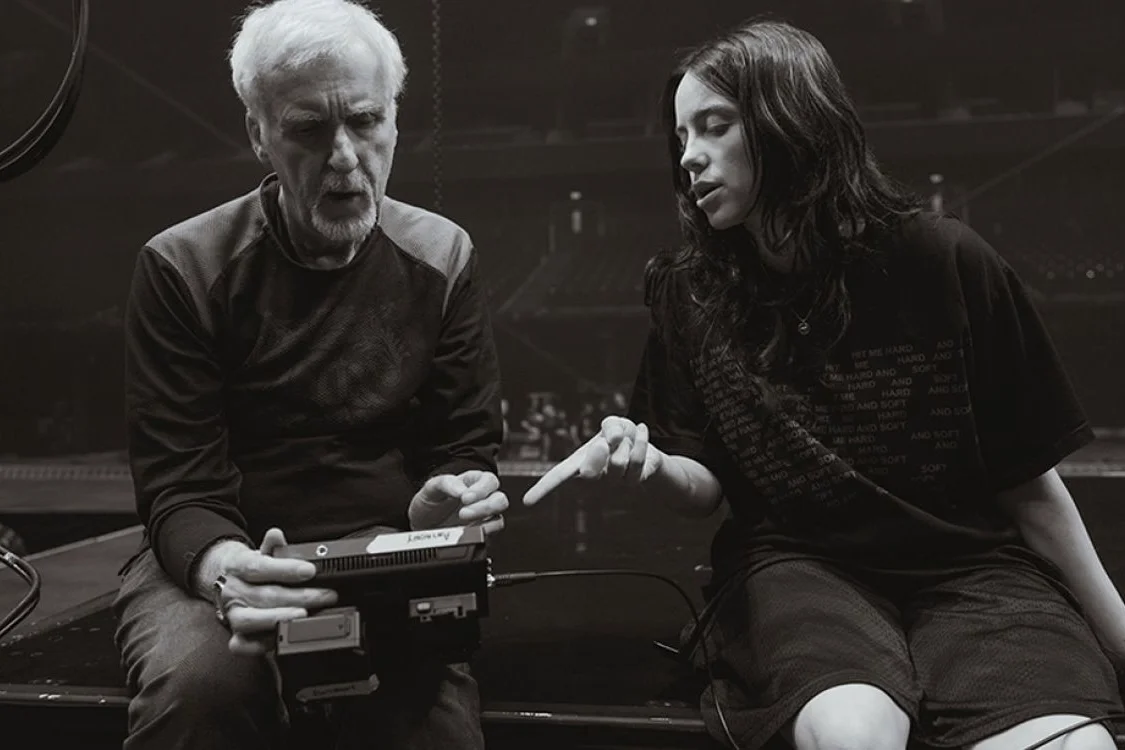
The director of Billie’s film is James Cameron. Even if his name does not immediately come to mind, you have almost certainly seen some of his work, such as Titanic and Avatar.
What Cameron is best at is not simply making images look spectacular, but making the audience believe they are truly inside a space. The sinking ship in Titanic, the planet Pandora in Avatar: the point is never only to “see” them, but to “enter” them. So when he comes to film a Billie Eilish concert, this is naturally not just another pop-star concert film.
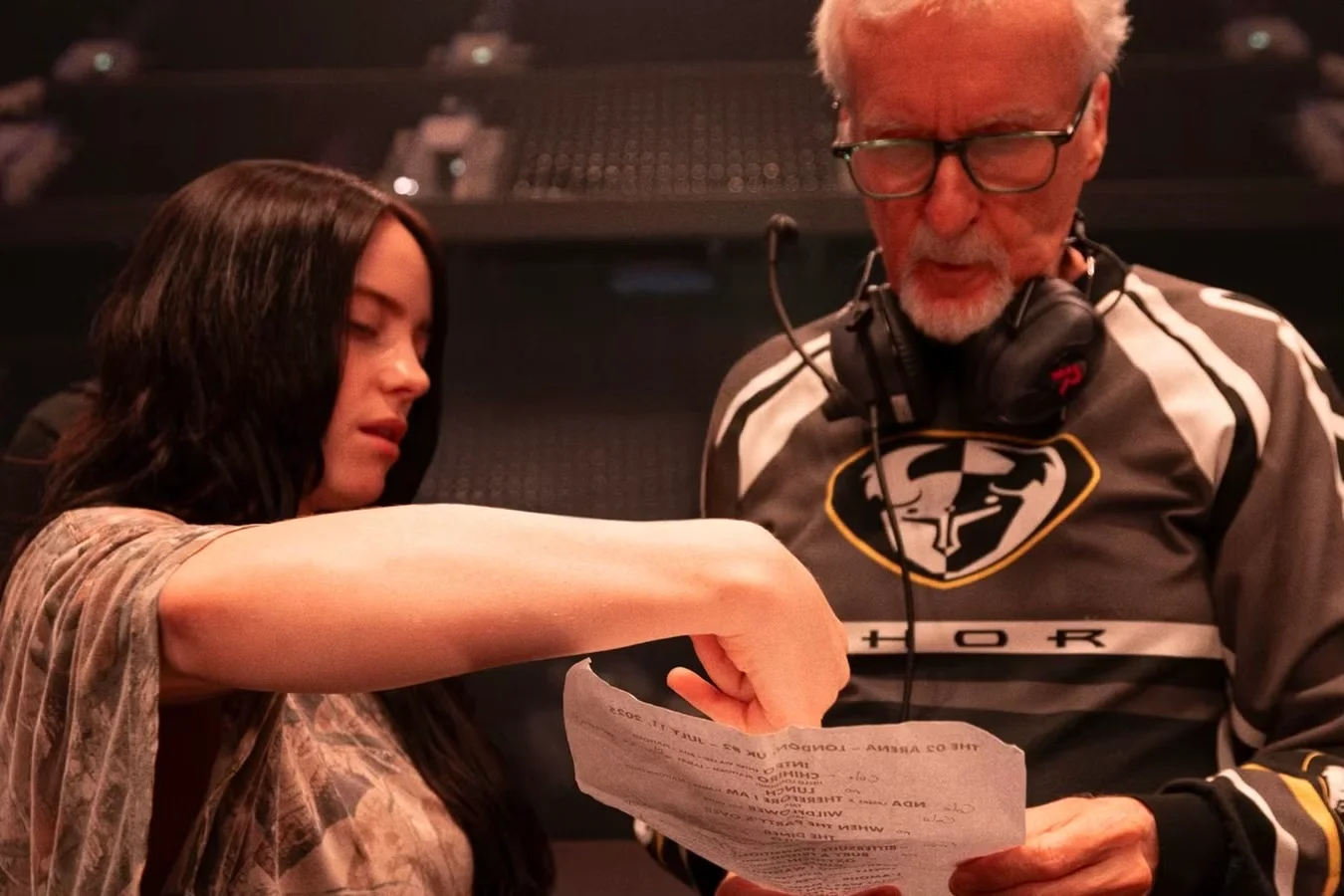
According to Billie, the collaboration began when Cameron first emailed her mother. His question was direct: why has no one shot Billie’s concert in 3D? Billie later described the idea as “insane” but brilliant, and almost immediately said yes.
The actual shoot was not a simple multi-camera recording either. The film mainly captures Billie’s Manchester shows from her world tour, using 17 cameras. Some were placed among the audience, while others were hidden in more discreet positions onstage. The aim was not only to capture the performance, but to reconstruct the collective emotion and spatial atmosphere of the tour.
▍3D concert films are not new. So what is different this time?
3D concert films are not new. From the classic U2 3D to Miley Cyrus, Justin Bieber, Katy Perry, and One Direction, there has long been a series of works using stereoscopic images to shorten the distance between idol and fan.
For many past 3D concert films, the central promise was to make fans feel closer to the idol. The idol seemed to step out from the screen; the stage effects became more dimensional; distance was reduced and adoration was amplified. In those cases, 3D often functioned as packaging, an extension of the commodified fan experience.
What makes the Cameron and Billie collaboration more interesting is that it does not seem to treat 3D merely as a gimmick for “getting closer to the idol.” Instead, through sound, lighting, screams, arena distance, and 3D depth, it turns all of these elements into part of the viewing experience.
In other words, the function of 3D here is not merely flashy visual stimulation, but a form of spatial design.
▍Sound mixing: the audience roar is not background
One of the most interesting choices in this film is its willingness to bring the audience’s sound into the foreground.
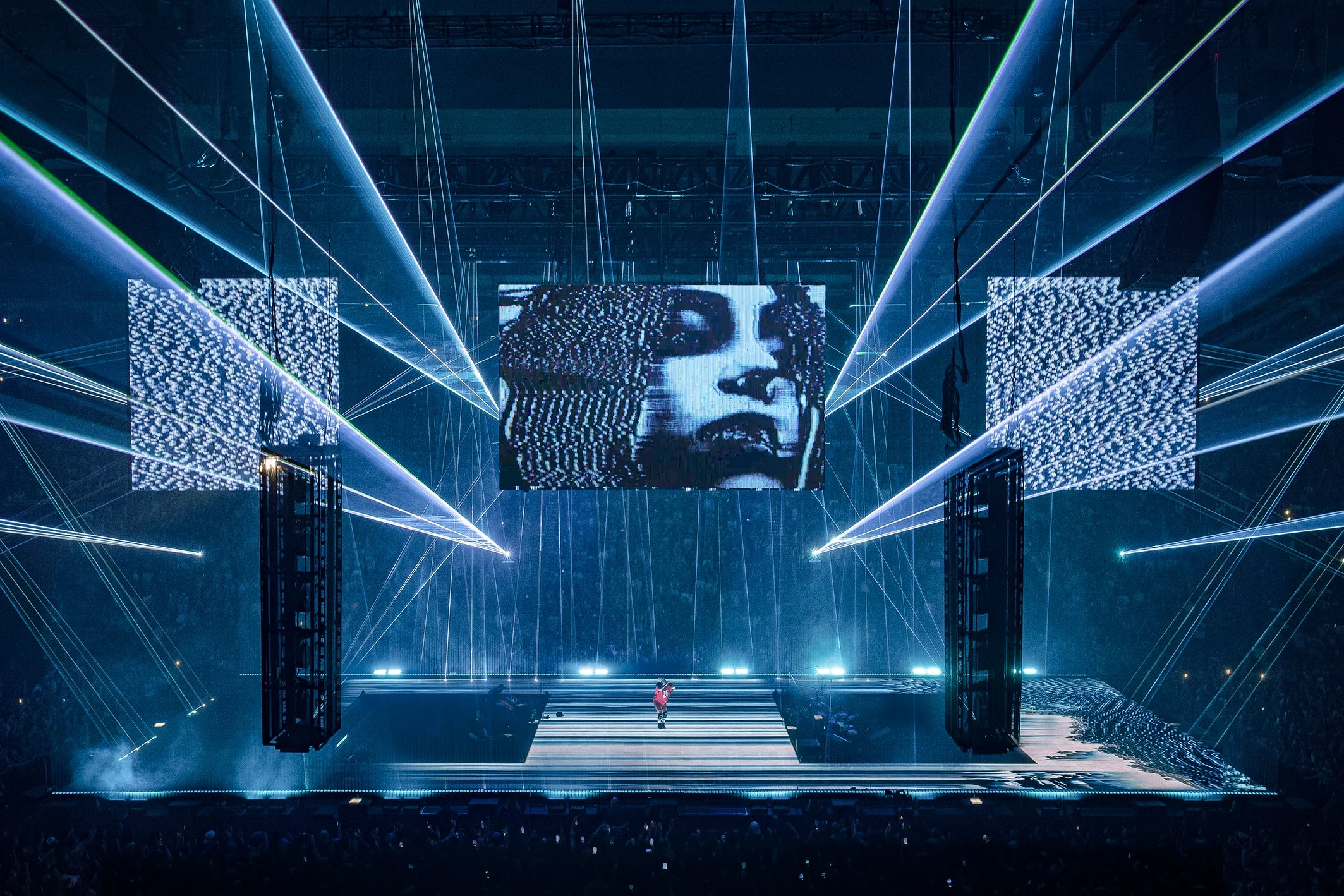
The screaming, singing, breathing, and shouting are no longer just background noise. At times, they are even louder than Billie’s voice. You do not only hear Billie; you hear how she is surrounded, answered, and pushed forward by an entire arena. The film clearly gives audience reactions an important place, turning the audience from mere spectators into something close to an additional character in the live scene.
Especially at the beginning of the film, what first “hits” you is not even the stage image, but the sound of the audience singing along. That wall of sound sits almost as far forward as Billie’s own vocal. It can create an intense sense of live immersion, but it can also become a form of interference.
Taylor Swift’s The Eras Tour offers a useful contrast in terms of sound treatment. Of course, The Eras Tour also contains huge audience singalongs and screams, but its overall sound mix is closer to a finely polished ideal performance: Taylor’s voice is placed firmly in the foreground, while the band, stage sound, and audience reactions each have a clearly defined position. The audience is present, and it matters, but it is mostly contained within a clean and controlled structure. You hear the crowd, but you never lose Taylor.
Everyone’s preferences differ. For me, the audience shouting in Billie’s film was indeed too loud at times, occasionally affecting my viewing experience. Combined with the 3D effect and the constant flashing lights of Billie’s concert, there were moments when I even wanted to take off the glasses and rest my eyes. Yet it is precisely this discomfort that makes the film worth discussing.
▍Why is Billie suited to this approach?
This difference is not only a matter of sound mixing. It also reflects the different stages these two pop icons currently occupy.
In The Eras Tour, Taylor is no longer a singer still in the process of building her body of work. She is a mature diva. Here, “diva” refers to a singer who has accumulated enough work, symbols, crowds, and historical weight to turn her own career into an exhibition that can be visited. She is no longer simply performing songs; she is curating her own history.
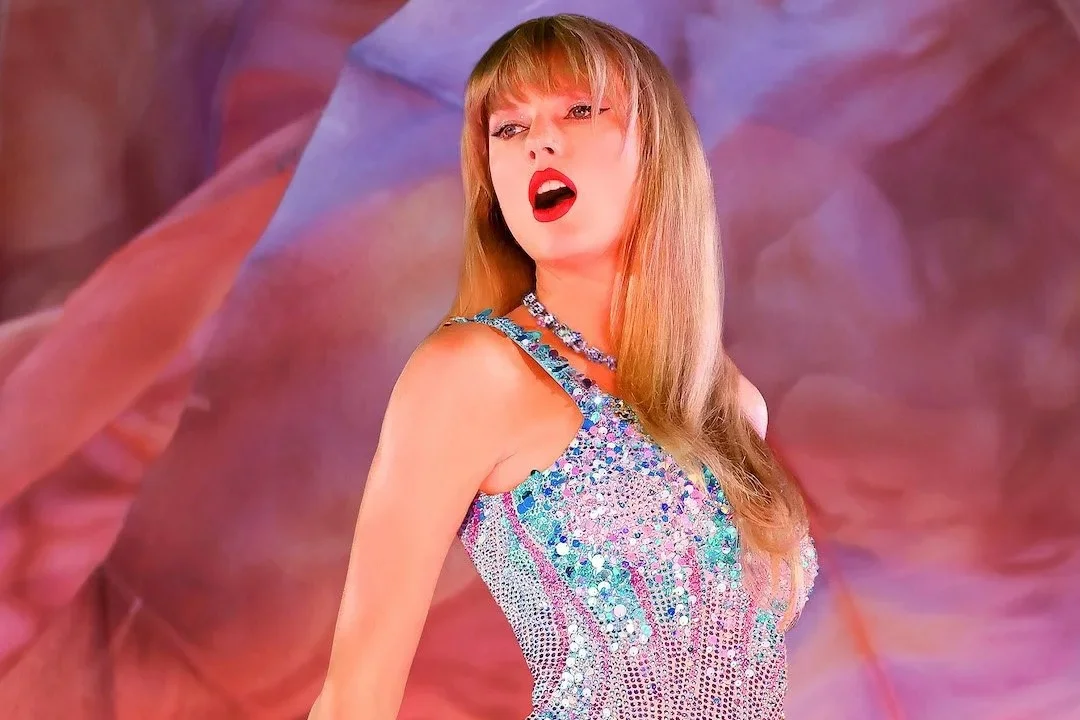
Therefore, Taylor’s presentation is necessarily a grand archive. Sam Wrench, who has directed performance films for many pop stars including BTS and Lizzo, designs a “best seat” aesthetic for the audience: a viewpoint from which everything can be perfectly seen. This approach serves Taylor’s diva presentation precisely. Taylor’s audience wants to see how an era has been built, organized, and fully unfolded onstage. Even details one might miss at the actual concert, such as the movement of a dancer’s costume or Taylor’s most iconic expressions and smiles, are carefully preserved by the camera.
Billie, however, is not a traditional pop diva. Her performance power does not come from total outward projection, but from a voice that is low, close, and breathy. In terms of her stage presence, she also places great emphasis on contagion and energy. Influenced by her love of hip-hop, from early on she often appeared in oversized hoodies, moving around the stage like a rapper, pulling the audience into jumping along with her. Rather than constructing a distant, detached world for the audience to observe, her stage feels more like an invitation to enter a shared emotional state.
Billie’s contradiction lies here: her voice is private, but her live show is already arena-sized. Cameron’s 3D and the audience-forward sound mix are dealing with precisely this contradiction: how can a kind of music that was once close to the ear, bedroom-like, and low-voiced be placed inside a massive venue without completely losing its intimacy?
But this is also where the risk lies. Billie’s sonic world is built on subtle whispers and delicate shifts in tone. When 3D, arena lighting, and audience roar are all amplified at once, that delicacy can sometimes be swallowed by the scale of the venue. This is also one of the criticisms some reviewers have raised: the stronger Cameron’s form becomes, the easier it is for the most elusive parts of Billie’s music to be pushed away.
▍What else can a concert film do?
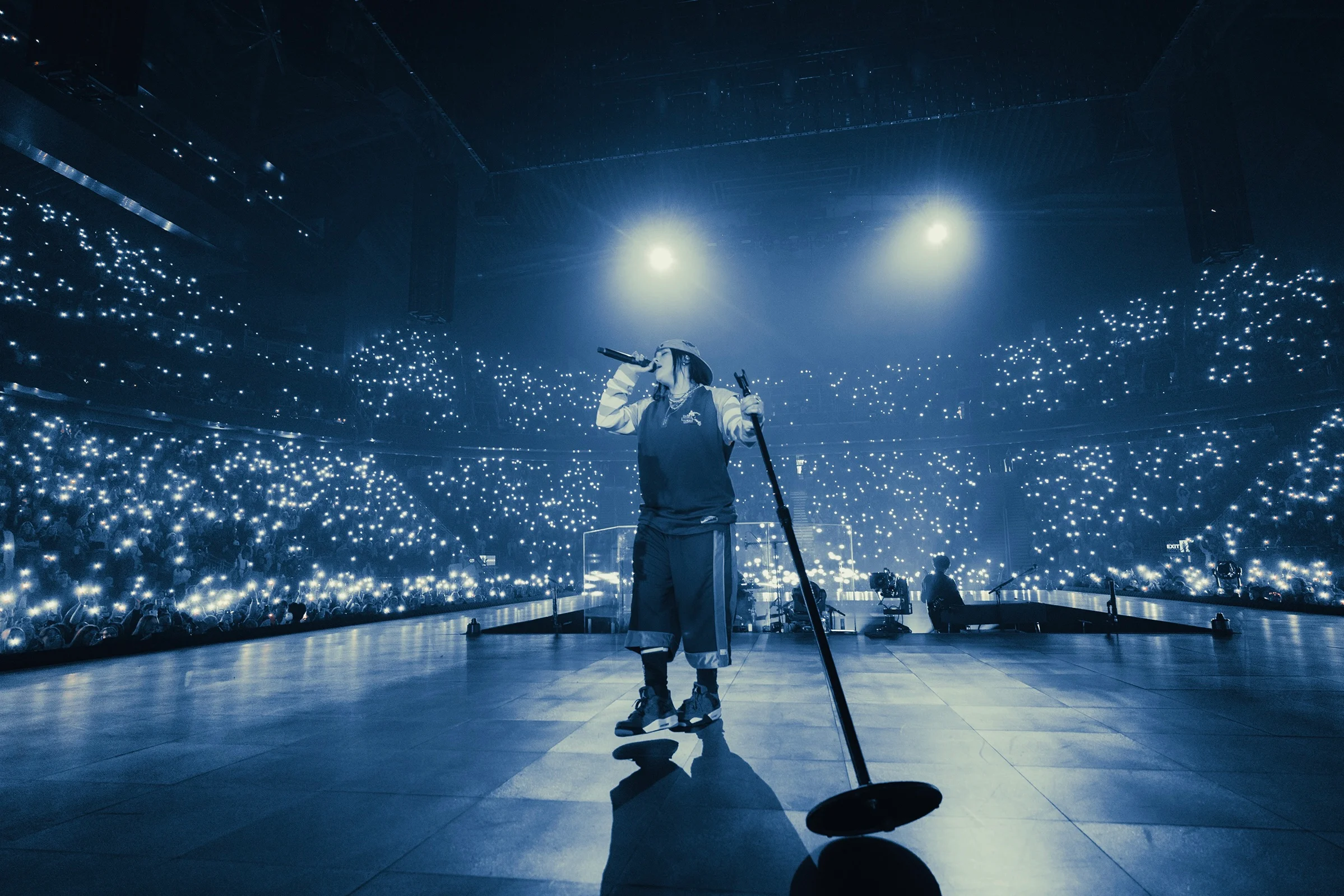
When so much music has been compressed into short phone videos, streaming-platform waveforms, and fifteen-second social-media highlights, the cinema has unexpectedly become a place that can once again hold collective bodies. People buy tickets not only to see the star more clearly, but also to confirm that they can still be shaken by the same sound together with a group of strangers.
In many screenings in the United States, fans reportedly walked to the front of the screen, turned on their phone flashlights, sang familiar lyrics, and danced in circles together. For many fans who may not have been able to get tickets, or who could not afford the live concert, the concert film also becomes a lower-cost collective experience.
In an age increasingly flooded with images, can the concert film become more than documentation? Can it become a way of redesigning our sensory position? Can it transform a live event that has already disappeared into another kind of experience that can be shared?
Of course, if we really had the choice, live would still be best. So let us all save up properly and go watch shows in stadiums.