(Beginning)
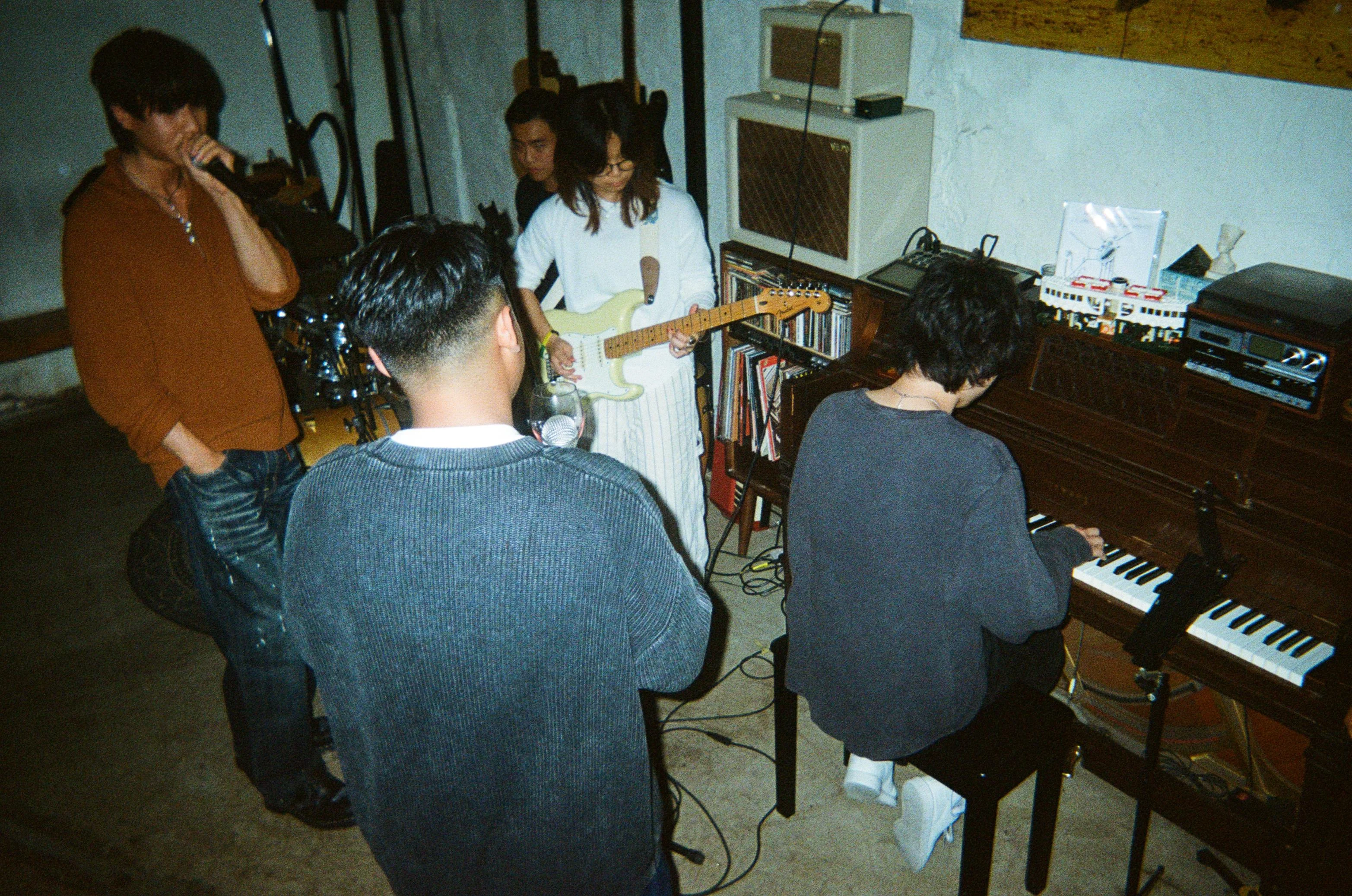
I suddenly realised that words are, in fact, merely an analysis of my own state of being. In the world of language, I dissect myself just as one would dissect a corpse; everything I have experienced, felt and depicted is, in fact, a record of my present self, achieved through the portrayal of others. It was also at a recent BlindCat gig that I began to realise that music and live performances are the connecting points between my various present moments; these moments are not disjointed, but are linked together in stages. I have often felt the urge to write more about the BlindCat independent music gigs I’ve been attending, but I am not the sort of person who can string music together with regular, objective prose. Rather than providing an introduction or a summary for each live performance, it seems I can only express the feelings I’ve experienced and internalised at the conclusion of a particular phase of my own journey. For instance, after many past gigs had ended, I’ve felt somewhat at a loss as to how to continue writing, even suffering from a sort of ‘writer’s block’ at times, until on those rare occasions when I’ve occasionally felt as though I’d finally found the way home whilst clutching a ‘toy’ I’d unearthed—yet when I actually put pen to paper, I’ve had no idea where to begin. For a while, I wanted to offer a very positive summary of this phase; both myself and the world around me have been submerged for far too long—would a joyful celebration of emotions be all we need? The answer is clearly no.
Perhaps the process of confusion and fluctuation has never been the problem, but has always been the answer itself. I have recently come to understand the concept and application of harmony in music; no note is absolutely incompatible with another. Throughout history, what musicians have done is simply to create, at the precise moment, a harmony that belongs to that very moment. This fusion fills the gaps and voids that words cannot articulate; such is the charm of music. All subsequent art forms have sought to compensate for those aspects that cannot be fully expressed, and so cinema has become the eighth art. In the fusion of sound and image—finally achieved through the continuous advancement of technology—we find vivid imaginings and memories. At times, fantasy and memory coexist; those shared subconscious elements only gently brush against our skin at a particular moment of transmission.
The process of gradually sinking to the ocean floor may have begun the very moment we were born. As we form all manner of connections with different people, our souls embark on a voyage into the unknown. Perhaps we will enjoy the gentle caress of the sea breeze at some moment, or perhaps we will gradually lose ourselves in the eddies of hidden currents; yet every descent and resurgence, whilst appearing to go with the flow, remains a choice we make for ourselves.
This summer is drawing to a close, and it has been quite some time since I attended several of my favourite Mojo Soup Concerts. I have not found a way to piece together those past fragments, so I shall take advantage of the tail end of August to boldly share the thoughts I had at the time. As long as someone reads them with care, it matters little whether this is the most perfect presentation.
(1) Gwenji’s Bittersweet Destiny
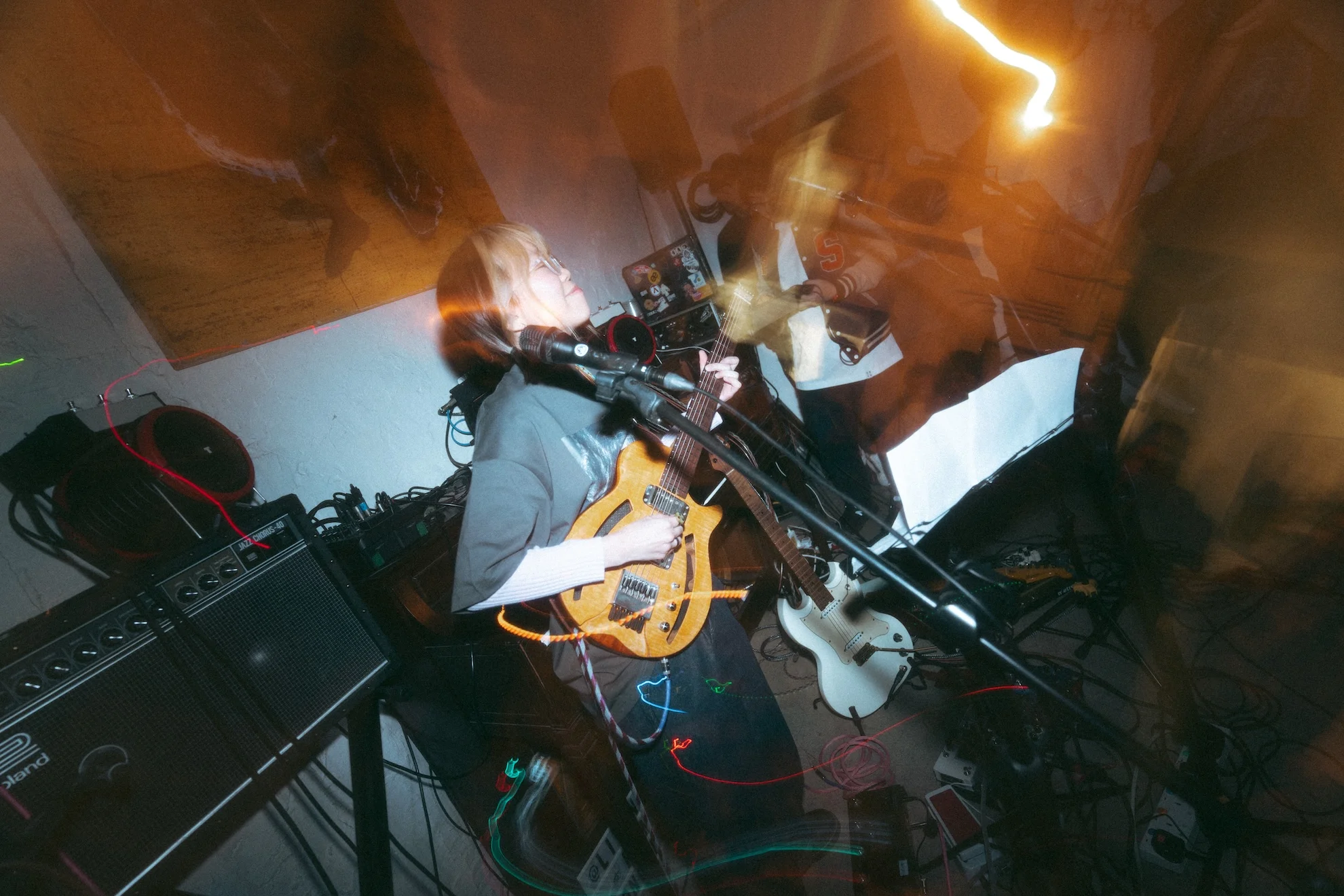
Perhaps the greatest beauty in the world—one that defies description—lies precisely in the everyday: fragmented states of being, emotions, thoughts and experiences, like a web of intersecting straight lines entangled together, taking on entirely different forms at different times. In the face of such complexity, language feels so flimsy and powerless—much like the empty spaces within a room, which, alongside the building itself, the furniture and the people, possess a transcendent significance of their own. It is precisely as Wittgenstein said: whatever can be expressed in language can be expressed precisely; and whatever cannot be expressed in language must be met with silence. That silence must be borne by the individual alone; we cannot articulate it, nor even prove that it ever existed. Yet at the moment when this helpless sense of loneliness nearly crushed me, music was like a flying carpet, catching the self as it plummeted into confusion and nothingness.
Gwenji’s performance at Mojo Soup in 2024 was the first live music experience I’d had since I’d truly settled into life in Hong Kong; every time I see her, memories of how I first discovered her music and BlindCat resurface amidst the everyday routines I’d otherwise overlooked. I vaguely recall that first time I went to Tang Yi; Gwenji’s voice was clear and soothing. Amidst the upheaval of work and moving house, it was the first time I’d felt a sense of pure beauty in Hong Kong. Unlike the crowded buildings, streets and the hurried pace of people’s daily lives, that beautiful voice wasn’t merely a simple image or mood—it carried a wealth of complex thoughts, which left a profound impression on me. It wasn’t just that first encounter; the second time I saw Gwenji at Tang Yi, we played ‘Werwolf’ together. Amidst the lively chatter and commotion, I finally felt I’d made friends in Hong Kong. Everyone there was so special, embracing each other’s quirks and oddities. My sensitive and twisted inner self, adrift in a foreign linguistic environment, had unexpectedly found a place to rest.
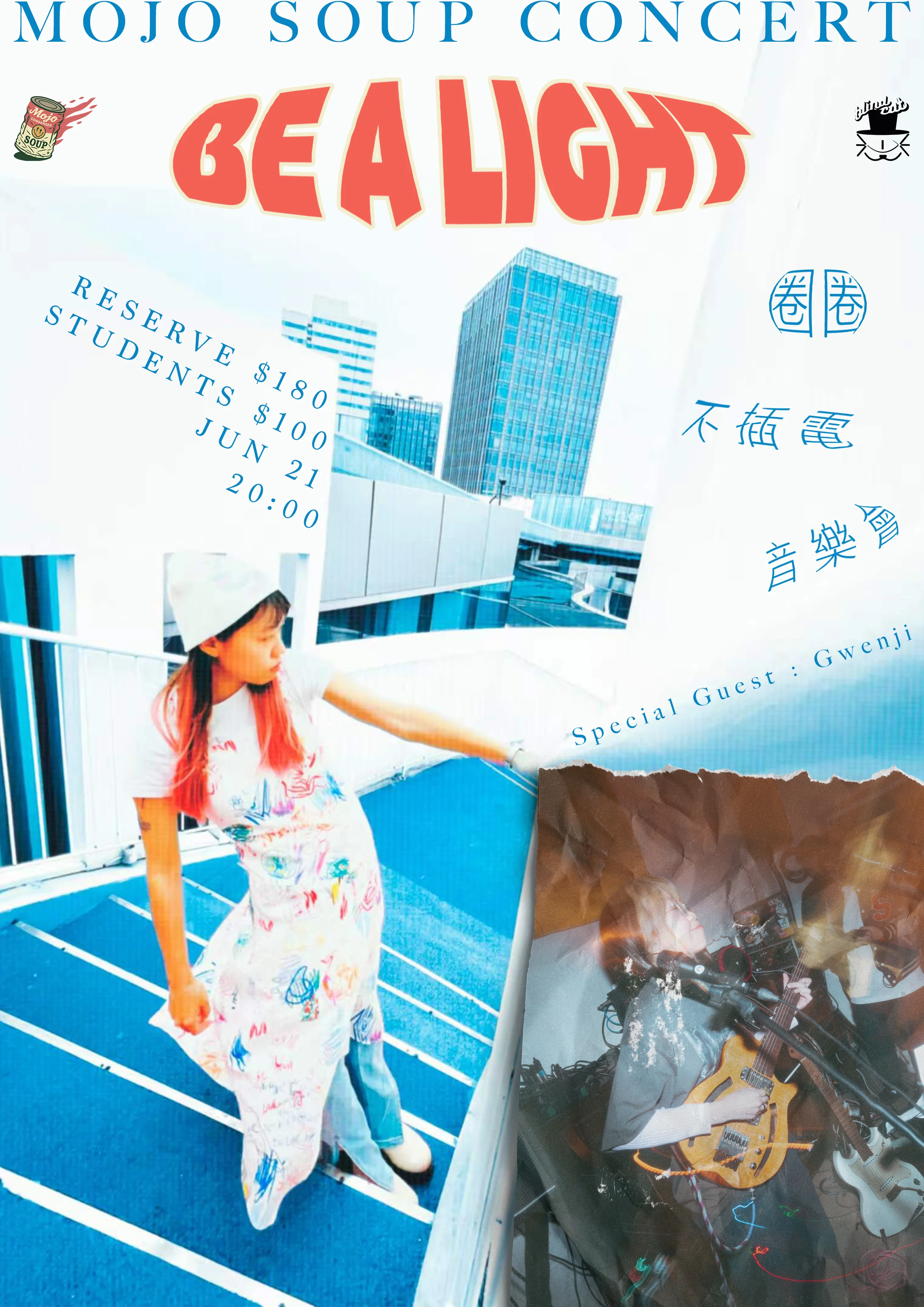
This third time I saw Gwenji at Tang Yi, she was the opening act for the ‘Be A Light’ concert organised by the ‘Circle’ community. Perhaps because I’d experienced more music and live performances, I’ve come to appreciate Gwenji’s songs more and more. It’s like trying restaurants from different countries or occasionally simmering a pot of delicious soup at home with care; whether it’s the complex melancholy of a rainy day in the arrangements or the vocal melodies that leap and flow like a stream, she becomes a dancing sprite within the space. Deep down, I’ve quietly come to see her as a prodigious young girl—both spirited and brave. My increasingly proficient Cantonese listening skills also meant that, for the first time, I was finally able to fully understand her remarks. It turns out that her creative work stems from the tiny fragments of everyday life—perhaps lessons on love, perhaps thoughts churning through her mind as she lies in bed, or perhaps simply those little moments spent cooking in the kitchen. These profound reflections, born from the minutiae of daily life, shape her complex personality and give rise to her ever-changing musical atmosphere. This complex and ever-shifting music acts like a mirror, allowing listeners to immerse themselves in it and see their own multifaceted selves—at times wise and clear-sighted, at other times confused, circling round and round within their emotions.
Gwenji’s Bittersweet Destiny has made me realise that in this city, every person hurrying past actually has a complex daily life hidden beneath their indifferent expression. In truth, we have always known this, but we often forget; and this awareness of the subtle beauty of everyday life only surfaces at certain moments—such as this one.
(2) The Girl Who Writes Poetry, The Damp Moon
Quanquan is the lead singer of the indie band Peach Illusion, hailing from Shaoguan. A charming young woman with her hair in twin plaits and the ends dyed pink, her lyrics—much like her appearance—are brimming with the vitality and imagination of adolescence, yet subtly reveal the sense of helplessness and confusion that comes with growing up.
From her singing and lyrics, it is clear that she is a girl who lives her life with depth; in the flowing stream of life, she will not easily lose her way, even when swept along by the current. In ‘It’s All Right to Screw Things Up’, she writes: ‘It’s all right to screw things up; it’s all right to give up when you’re hurt. The good thing is, we haven’t lost the ability to love. Only then do we realise that most things, even if we try our hardest, may not have a happy ending—but that’s all right. Just remember to love yourself.’ This courageous consolation, accompanied by the humid, misty melodies of South China, stands as a rebellion against the trend of short, fast-paced rhythms. Through poetry and lyrics, she uses poetic imagery to counter the turmoil of the present age. When Mandarin, Cantonese and English resound simultaneously within the tenement blocks of Sham Shui Po, I wonder if it is in moments like these that, through poetry, we return to that original, unadulterated goodwill and beauty. As it becomes ever easier to mess things up, and the criteria for what constitutes a ‘mess-up’ grow increasingly uncertain—with courage and the cost of trial and error burdened by countless conditions—might harmony itself become something that simply doesn’t fit into this discordant world?
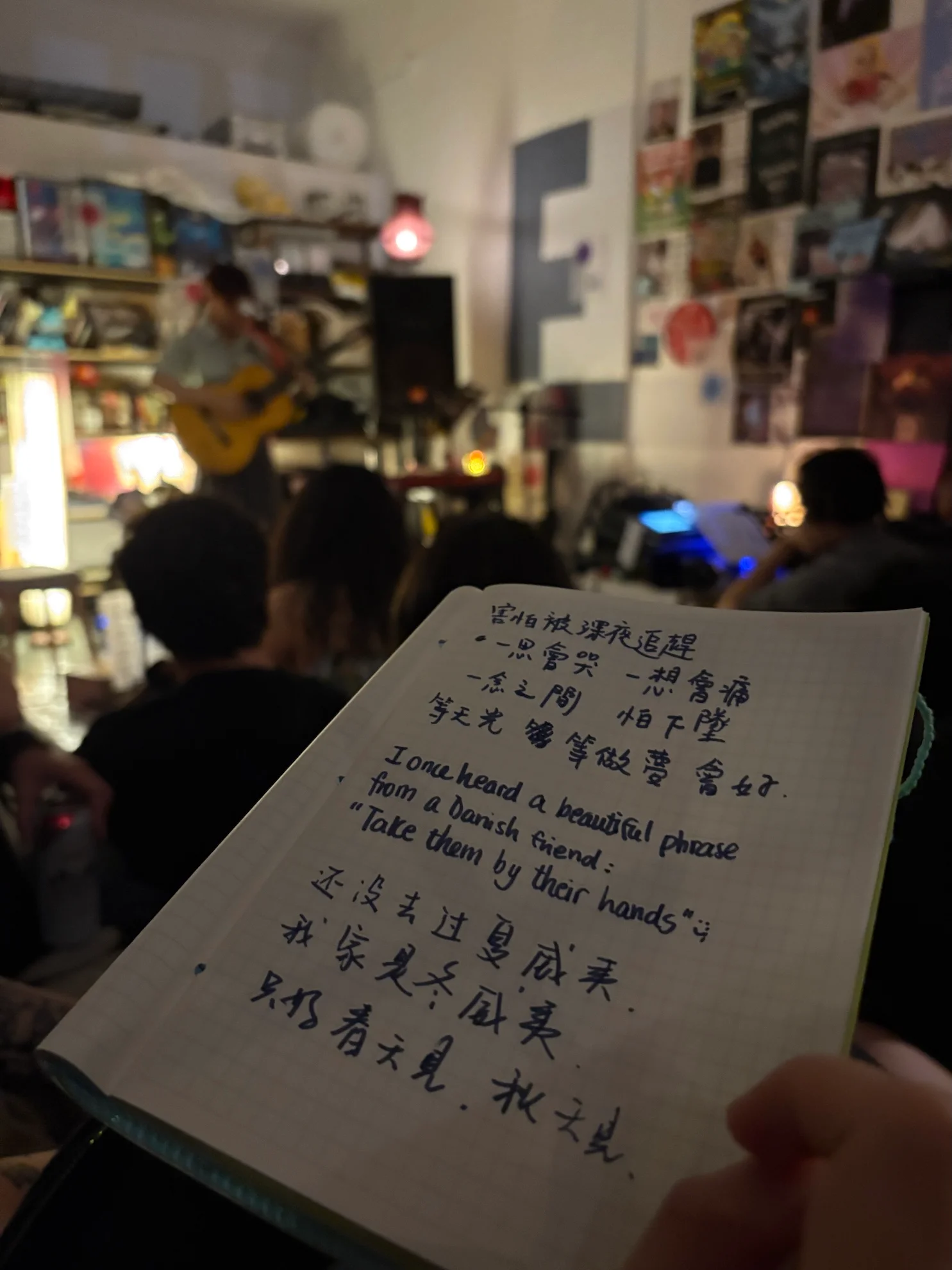
During the performance, Qianqian passed a notebook around to the audience, containing verses written by spectators from different cities at each stop on the tour. Some were perhaps simply a line expressing a momentary mood, whilst others captured someone’s state of mind at that time. She collected these verses at every venue and, at the end of the show, sang a brand-new song using everyone’s verses—a sight that inevitably brought to mind the minstrels of old. Perhaps they, too, would have captured the fleeting moments of all passers-by on a canvas of musical notes whilst travelling. And those beautiful moments—be it a dewy dawn, a sun-drenched afternoon, or a star-studded night—I believe such a wonderful ‘vocation’ ought to be something more people aspire to!
(3) A Band of Youth
Although the muggy heat of early summer can be uncomfortable, its restlessness brings with it a longing to break free from the ground. With the gentle warmth of spring’s vitality still lingering, a quiet rebellion against the heat begins to take hold. It is no exaggeration to say that early summer is the season of youth. Riding on this energy, the young band All Around delivered a youthful performance at Mojo Soup. The nine-piece band took to the stage in force, filling Tang Yi’s modest stage to capacity. The audience did not disappoint either; those in the front rows were practically facing the instruments as they revelled in the performance. It is rare to experience such a crowded, up-close live show; usually, physical discomfort prevents one from becoming fully immersed. Yet the human body can only ignore such physical constraints when adrenaline is surging through the veins. That surge of adrenaline was precisely the defining experience of this passionate performance.

The young musicians’ masterful command of their instruments is merely the beginning of their passion for music; the chemistry and interaction between the members are even more crucial elements of the overall picture. the two lead vocalists and one backing vocalist, each with a unique vocal timbre; the piano and guitar flowed effortlessly, as if fuelled by inexhaustible energy—whether in the movement of their fingertips or the conception of the notes; the rhythm section was equally impressive, with the bass making a particularly strong presence. Their innocent and passionate faces always evoke memories of youth in everyone—that marvellous age we can only ever recall but can never truly inhabit again. Time leaps and flows like a stream; we cannot fathom the curves it takes as it passes through our days, nor do we remember the cool, refreshing sensation of that stream running through our fingertips. All that remains are the fervent memories of frolicking and letting off steam with our friends.
(End)
I constantly remind myself to seek harmony and balance, yet in the heat of the moment, we often cannot see clearly where we stand—just as the beauty and grandeur of this summer are only now taking on clear contours in our memories.
There is nothing more to say; I only hope that such a glorious summer may be repeated time and again, and that the vitality of Hong Kong’s independent music scene may remain forever young, forever brimming with tears of joy.