▍Arturia MiniFreak 49 turns its modulation matrix into a playing surface
Arturia's MiniFreak 49 retains the six-voice architecture of two digital engines and individual analogue filters, adding 49 full-size, semi-weighted keys. Its pressure-sensitive XYZ touch matrix handles modulation routing as well as performance: in Freak Control mode, horizontal and vertical movements and pressure can reshape sound and rhythmic parameters together. A Hold function keeps a gesture in place after the player lifts their hand.
The new Filter FM control applies audio-rate modulation from either oscillator to the analogue filter, while Voice Panning distributes individual voices across the stereo field. Sample and wavetable memory increases to 256 MB. The included MiniFreak V mirrors the expanded instrument, although its MiniFreak 49 mode requires a registered licence for the new hardware.
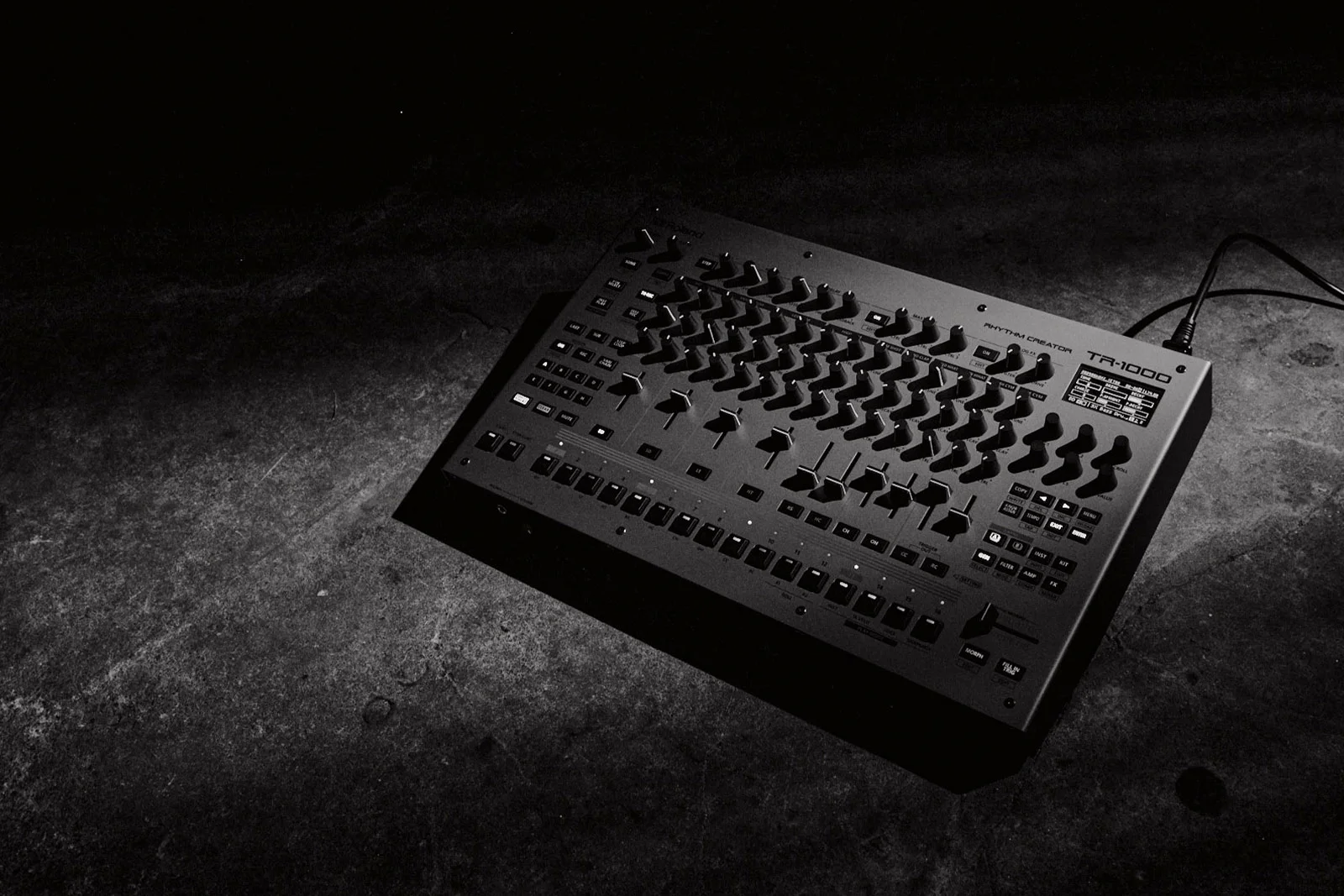
▍Roland TR-1000 1.50 adds per-step notes and Keyboard Mode
Roland's TR-1000 update makes pitch a more direct part of drum-machine programming. Version 1.50 introduces a NOTE parameter for individual steps and a Keyboard Mode played from the step keys, both for compatible sound generators. It also adds 50 FM instruments from the TR-8S library, extending the palette for melodic and percussive parts.
For live sets, KEEP KIT EFX & EXT IN carries the current effects and external-input settings across kit changes, allowing reverb, delay and external-input sound to continue. Revised AFX routing can send the analogue effects signal exclusively to its dedicated output; it does not give every internal effect a separate output. Roll, reverse panning delay and SBF-325 effects are also added.
The LXR-02, developed by Erica Synths and Sonic Potions, combines six drum-synthesis voices with a step sequencer. Erica Synths has now published its firmware source, allowing developers to study and modify the voices, effects and sequencing, then build an update image for the hardware.
The repository uses GPLv3 licensing. This is a software release rather than an open-hardware design, and it does not itself announce a new collection of sound engines. Erica Synths continues to support only the original firmware; users take responsibility for installing community versions. The release gives people interested in changing the instrument an explicit, manufacturer-authorised starting point for that work.
Erica Synths adds a CHORD algorithm to the Pērkons HD-01's third voice in firmware 1.3. One parameter moves through waveforms while another selects the chord. It replaces one of the existing Karplus modes, rather than retaining every previous mode alongside the addition. Real-time chromatic quantisation also lets voice pitches follow semitone steps.
Each bank can now use its own sample set, so different pieces need not share one collection of samples. The BBD delay gains dotted-note timing divisions, while a tune parameter lock lasts until the next trigger, removing the need to repeat it across successive steps. The official firmware is available as a free download for existing Pērkons HD-01 owners.
▍Groove Synthesis 3rd Wave Terminal builds wavetables and multisamples from audio
Groove Synthesis's 3rd Wave Terminal brings sample and wavetable editing to a computer screen. Users can import audio to create wavetables and multisamples, draw waveforms and edit recorded sequences in a piano roll. Modulation can appear as a list, a matrix or virtual patch cables.
The application began as composer Pedro Macedo Camacho's personal project, before becoming a collaboration between Ocean Control and Groove Synthesis. Its librarian lets users audition sounds before transferring them and prepare performance banks offline. Terminal runs on macOS and Windows and supports the 24K, 24M and 8M. Registered hardware owners can download it at no cost; the connected synthesiser requires OS 2.0d or later and a USB connection.
▍Yamaha adds CK76 and expands split playing with CK OS 2.0
Yamaha's CK76 sits between the CK61 and CK88, with a 76-key, semi-weighted FSB keyboard. It retains the series' organ drawbars and dedicated filter and effects controls. Built-in stereo speakers and battery operation allow playing without an external amplifier, while a microphone or another instrument can be connected and processed through the onboard effects.
Released alongside it, CK OS 2.0 also updates existing CK instruments. Advanced Split Mode expands the key-range assignments for the three Parts, allowing a Part to cover several zones and overlap with others in selected areas. New electric-piano sounds and 16 Live Sets are added. The update serves the CK series, rather than being exclusive to the new CK76.
Deeply rooted in the Hong Kong live music scene, GIGzine is committed to promoting local music culture. We provide the latest gig guides, alongside artist interviews and in-depth columns that explore the creative stories behind the music. Whether you're searching for your next gig or discovering new sounds, GIGzine is your starting point to connect with Hong Kong's music!